
A Couple’s Duet of Love & Lust
Play A Couple’s Duet of Love & Lust
A Couple’s Duet of Love & Lust Screenshots
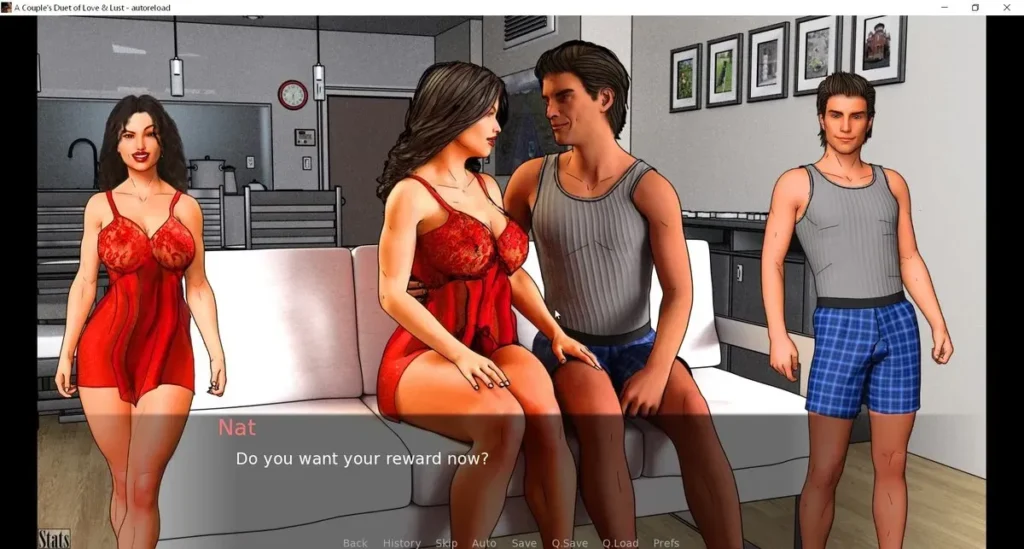



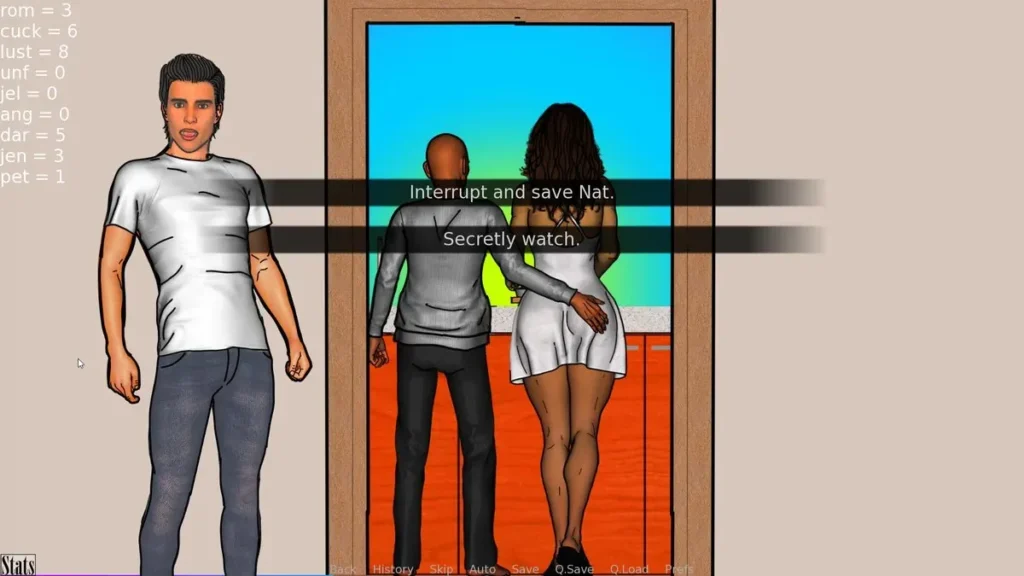








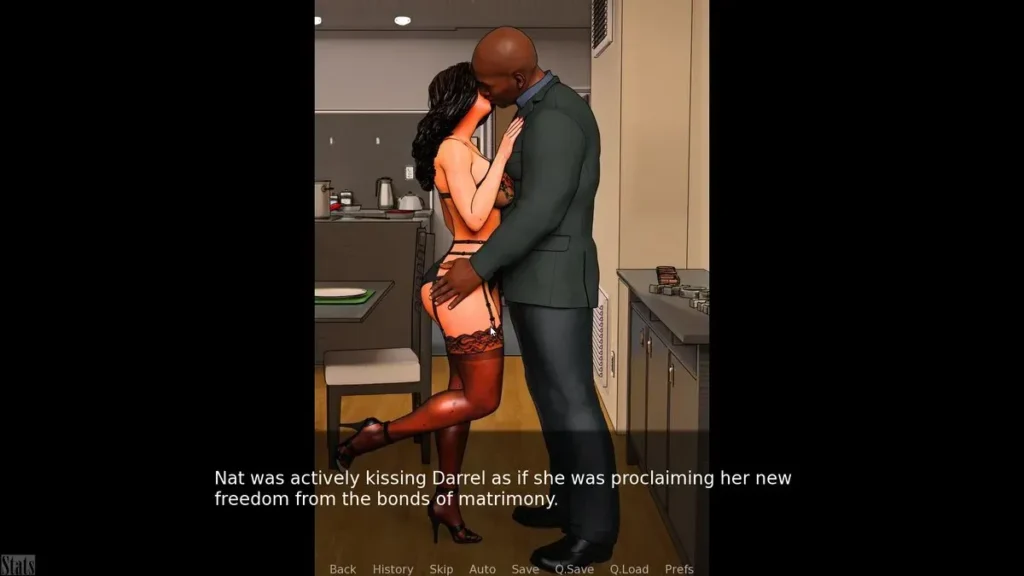






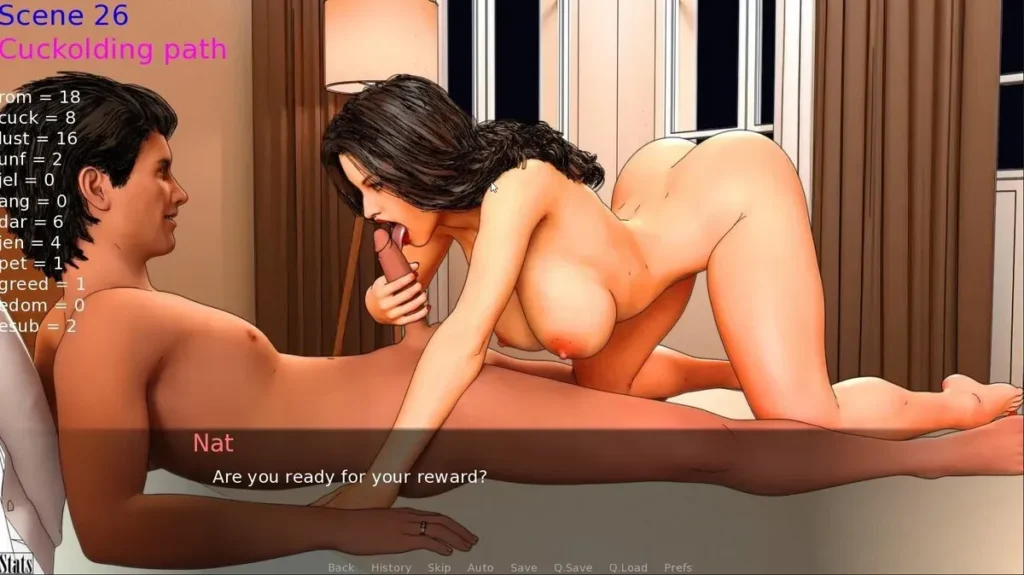





A Couple’s Duet of Love & Lust review
Master the interactive storytelling experience with decision-making strategies and relationship dynamics
A Couple’s Duet of Love & Lust stands out as an immersive interactive narrative experience that puts you in control of a young married couple’s destiny. This game combines complex decision-making with personalized storylines, allowing players to shape the relationship dynamics between protagonists Ethan and Natalie as they navigate life in a new neighborhood. Whether you’re drawn to strengthening their bond or exploring unconventional paths, the game offers multiple endings and branching narratives that respond to your choices. Understanding the game’s mechanics, relationship systems, and key decision points will help you unlock the full potential of this engaging interactive adventure.
Understanding A Couple’s Duet of Love & Lust: Core Gameplay Mechanics
Ever booted up a game expecting a straightforward story, only to realize you’re not just playing a character—you’re managing the delicate, thrilling, and sometimes terrifying ecosystem of an entire relationship? 😅 That’s the immediate, captivating hook of A Couple’s Duet of Love & Lust. This isn’t a spectator sport; you’re the director, the therapist, and the little devil (or angel) on both characters’ shoulders. The core magic lies in its dual protagonist storytelling, a brilliant mechanic that hands you the hearts and minds of both halves of a young married couple, Leo and Chloe, as they navigate life in a new neighborhood. Every choice you make for one inevitably ripples through the other, creating a uniquely personal interactive decision-making game.
Forget single-perspective narratives. Here, true power—and true challenge—comes from wearing two hats. You’ll guide Leo’s after-work conversations and steer Chloe’s reactions to their new, intriguing neighbors. This dual protagonist storytelling approach transforms the experience from a simple choose-your-own-adventure into a nuanced relationship dynamics simulation. It forces you to think empathetically and strategically, constantly asking: “If I make Leo do this, how will Chloe feel? What secret desire or insecurity of hers does that touch?” Mastering this push-and-pull is the key to unlocking the game’s profound depth.
How Decision-Making Shapes Your Story
At its heart, A Couple’s Duet gameplay mechanics are elegantly simple: you read, you feel, you choose. But the implications are wonderfully complex. The game presents you with countless decision points, from mundane daily interactions to pivotal, heart-pounding moments of intimacy or conflict. Each choice is a brushstroke on the canvas of Leo and Chloe’s marriage, defining not just the plot, but their very personalities.
The genius of this interactive decision-making game is its cause-and-effect web. A decision is never just a yes or no; it’s a signal that adjusts multiple hidden meters, influences future dialogue options, and can quietly lock or unlock entire story branches hours later. It’s about understanding the subtext. For example, when the charming and confident neighbor, David, invites Chloe for a casual coffee, do you, as Chloe:
* Politely decline, citing prior plans with Leo? 🔒
* Accept enthusiastically, eager for a new friendship? 🔓
* Accept, but feel a flutter of excitement you keep to yourself? 🔓🔓
This single moment isn’t just about coffee. It’s a test of Chloe’s contentment, her curiosity, and her commitment. The choice you make feeds into the game’s sophisticated relationship dynamics simulation, tweaking hidden scores for traits like Trust, Curiosity, and Satisfaction. What’s more, you’ll likely face a follow-up decision as Leo later: “Chloe mentioned she had coffee with David. How do you feel about that?” Your choice here—be it supportive, indifferent, or subtly jealous—paints a completely different picture of Leo’s character.
Pro-Tip from a Seasoned Player: Don’t reload saves the moment a choice leads to tension! Some of the most authentic and gripping storytelling in this multiple endings game comes from navigating the fallout of a “mistake.” A jealous outburst or a secretive lie can lead to raw, dramatic scenes that deepen character development in ways perfect harmony never could.
Let’s walk through a concrete example to see these A Couple’s Duet gameplay mechanics in action.
Scenario: Leo is working late (again). Chloe is home alone when an invitation to a vibrant neighborhood party arrives. You control Chloe’s response.
Choice 1 (The Conventional Path): Chloe texts Leo, “Party tonight! Can you try to leave early? Miss you.” She waits for his reply before deciding.
* Immediate Outcome: Leo feels valued and prioritized. His “Romance” meter ticks up.
* Branching Effect: This path often leads to a sweet, unified arrival at the party. Story options focus on them as a team, navigating the social scene together.
* Character Development: Reinforces Chloe’s role as a communicative and patient partner, strengthening the “traditional” marital bond.
Choice 2 (The Independent Spark): Chloe replies, “Sounds fun! I’ll go ahead and save you a seat.” She goes to the party alone.
* Immediate Outcome: Chloe’s “Independence” stat increases. Leo might feel a pang of something—neglect or worry—when he gets the text.
* Branching Effect: At the party, alone, Chloe has completely different interactions. She might bond deeply with another character like David or his wife, Sophia, in ways she wouldn’t with Leo present. Leo, arriving later, walks into a dynamic he’s not part of, setting up potential for jealousy or admiration.
* Character Development: Begins to paint Chloe as more self-assured and Leo as potentially insecure or proud, depending on his later reactions. This is a prime step onto an unconventional branching narrative path.
See how one decision doesn’t just change a scene—it alters character trajectory, relationship balance, and available future story? This intricate cause-and-effect is what makes every playthrough feel uniquely yours.
Relationship Dynamics and Character Development
If decisions are the inputs, then the relationship matrix is the living, breathing engine processing them. A Couple’s Duet of Love & Lust moves far beyond a simple “love meter.” It employs a sophisticated, multifaceted relationship dynamics simulation that tracks four core emotional axes: Romance, Jealousy, Lust, and Emotional Submission. These aren’t just numbers; they are the psychological profile of your unique version of Leo and Chloe.
- Romance 💖: This measures emotional intimacy, tenderness, and traditional romantic gestures. High romance leads to supportive dialogues, loving gestures, and a strong foundation of friendship within the marriage.
- Jealousy 👁️: A potent and dangerous spice. A little can create exciting tension and possessive passion. A lot can breed distrust, bitter arguments, and controlling behavior. Your choices constantly feed or starve this green-eyed monster.
- Lust 🔥: This is the raw, physical attraction and desire, both within the marriage and potentially directed outward. It fuels passionate encounters and risky decisions. Balancing lust with romance is a classic challenge.
- Emotional Submission 🕊️: This fascinating metric tracks power dynamics. Does one partner consistently yield to the other’s emotions or decisions? High submission in one character might indicate a nurturing dynamic or a loss of agency, leading to very different story resolutions.
Your choices directly raise or lower these stats for each character individually. Crucially, the stats are not shared. You might have a Chloe brimming with Independence and Lust while your Leo is high in Romance and Jealousy—a volatile and dramatically rich combination! The game’s narrative constantly checks these values to determine which dialogues, scenes, and branching narrative paths become available.
To see how this works in practice, let’s look at how different choices impact these hidden metrics:
| Scenario & Choice | Romance | Jealousy | Lust | Emotional Submission | Potential Story Shift |
|---|---|---|---|---|---|
| Chloe compliments Leo’s effort on a hard day. | Chloe (+), Leo (+) | — | — | — | Opens up tender evening scenes; reinforces stable marital path. |
| Leo secretly looks through Chloe’s phone. | Leo (–) | Leo (+++) | — | Chloe (unaware) (-) | Unlocks confrontational arguments; may start a “suspicion” story branch. |
| Chloe flirts lightly with David at the community pool. | — | Leo (if he sees) (+) | Chloe (+), David (+) | — | Initiates “attraction outside marriage” arc; can lead to secret trysts or renewed marital passion. |
| Leo insists on staying home instead of going to Sophia’s art show. | Chloe (-) | — | — | Chloe (if she yields) (+) | Can build resentment in Chloe; may make her more susceptible to outside validation. |
This system is the core of character personality development. Leo isn’t predefined as “the jealous husband” or Chloe as “the curious wife.” You sculpt them through a thousand tiny decisions. A Leo who starts off secure can become paranoid. A Chloe who begins reserved can transform into a woman boldly pursuing her desires. The neighborhood setting acts as a catalyst, with each new character—like the enigmatic David or the free-spirited Sophia—serving as a mirror or a spark, reflecting or igniting what’s already bubbling beneath the surface of your couple’s marriage.
Exploring Multiple Endings and Storyline Paths
Here’s where your strategic choices and nurtured dynamics crescendo into a finale—or several. A Couple’s Duet of Love & Lust is the very definition of a multiple endings game. We’re not talking about a simple “good, bad, and neutral” trio. We’re talking about a spectrum of conclusions that feel like the organic, earned result of every conversation, every glance, and every secret kept or shared.
The game’s structure is a vast, interconnected web of branching narrative paths. Think of it less like a fork in the road and more like a growing tree. An early choice (like the solo party decision) might place you on a major limb—say, the “Exploring Independence” branch. From that limb, subsequent choices lead to smaller branches (“Reignited Passion with Leo” vs. “Deeper Connection with David”). This continues until you reach the very specific leaf that is your ending.
These endings range from the heartwarmingly conventional to the thrillingly taboo. You might guide Leo and Chloe to:
* A Renewed Vow: Overcoming temptations to forge a stronger, more communicative marriage.
* A Quiet Understanding: Settling into a companionate, perhaps less passionate, life together.
* A Passionate Realignment: Explosively renegotiating the terms of their relationship in an open or dynamic new arrangement.
* A Fractured Union: Succumbing to jealousy, lies, and broken trust, leading to separation or bitter coexistence.
* A New Dawn: One or both partners finding a more authentic life and love elsewhere, for better or worse.
The incredible replayability factor comes from this vast possibility space. My first playthrough was a cautious, “perfect couple” run that ended in sweet, if slightly dull, stability. On my second, I let curiosity guide Chloe and pride guide Leo, resulting in a dramatic, emotionally charged finale I couldn’t have predicted. I discovered entire scenes, character backstories, and intimate moments that were completely absent from my first playthrough. This is the hallmark of a masterful interactive decision-making game—it rewards not just different choices, but different philosophies of play.
To truly master this experience, you must embrace the role of a biographer, not a puppeteer. Let the characters breathe, let them be flawed, and let the consequences land. Pay attention to the game’s subtle environmental storytelling in the new neighborhood; a comment about a beautiful garden or a closed door can be a narrative clue. Most importantly, talk to your partner—both of them. Often, the most revealing choices come in quiet, private moments with Leo or Chloe alone, where they voice their deepest insecurities or wildest dreams.
Ultimately, A Couple’s Duet gameplay mechanics offer more than just a game; they offer a profound sandbox for exploring the complexities of the human heart. By mastering the dual protagonist storytelling, you gain an intimate understanding of how relationships are built, tested, and transformed—one deliberate, pulse-quickening choice at a time. Your unique duet of love and lust awaits its composer
A Couple’s Duet of Love & Lust delivers a unique interactive experience where your choices genuinely matter. By understanding the game’s decision-making system, relationship dynamics, and narrative structure, you can craft the story you want to experience. Whether you prefer strengthening the couple’s bond or exploring more adventurous paths, the game’s branching narratives ensure that each playthrough feels fresh and personalized. The depth of character development and multiple endings provide substantial replay value, making it an engaging choice for players who appreciate narrative-driven games with meaningful consequences. Start your journey today and discover how your decisions shape the couple’s destiny.